Friday, February 15, 2013

Bring On The Cake

Just in case celebrating Valentine's Day yesterday didn't fulfill your need for a good time this week, or you're looking for the perfect reason to begin your weekend celebrations today, here's a tidbit worth celebrating....


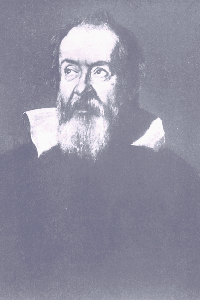
Born February 15, 1564, Galileo Galilei risked his life to bring science to the common people. At a time when heliocentricity was considered heresy, Galileo worked to show that Nicolaus Copernicus' model of the heavens more accurately described the motions of the heavens than the geocentric model proposed by Ptolemy and supported by the Catholic Church. Galileo developed numerous experiments that illustrated the differences between the two models, and despite the current scholarly standards of writing scientific data in Latin, Galileo wrote and distributed his work in the common tongue of Italian -- making the knowledge accessible to poor and rich alike. In his book, Dialogue Concerning the Two Chief World Systems, Galileo mocked the Catholic Church and the followers of Ptolemaic model (among other issues also discussed in the book) and in so doing, infuriated the Pope and the Church. Being a friend of the Pope, Galileo was saved from the typical fate of heretics -- death -- but was sentenced to house arrest for the rest of his life. Galileo died in 1642, blind and having forever changed the history of science.

At the links provided, you can read more about his life and his work. Perhaps the most common-knowledge notable accomplishment of Galileo's came when he used a telescope to look at the heavens. He was the first to look at the Moon and Jupiter through a telescope. He believed that there were seas on the Moon, and his names are still in use today, even though they are areas of cooled lava flows. Additionally, in his honor, the four largest moons of Jupiter (which he observed himself and sketches of remain in his writings) have been collectively named the Galilean Moons. Next time you have the chance to catch Jupiter in the night sky, take a look.... I watched nightly for a week myself.... It is simply amazing to realize that we can watch these moons orbit Jupiter from such a great distance without the aid of humongous telescopes!

Sources:

  1. Course I took at Mt. San Jacinto College, Astronomy 101, instructed by Dr. Daniel Barth
  2. Rice Biography
  3. DCTCWS translation

Russian Fireball Goes Boom!!!!!!

Citizens of Chelyabinsk, Russia witnessed a meteor flying through the atmosphere around 9:30 in the morning local time yesterday. The meteor lit up the sky and was brighter than the Sun, leaving smoke trails in the sky. A sonic boom echoed across the area, the shock wave breaking glass as it passed over the land. For those unfamiliar with sonic booms, this phenomenon occurs when an object is moving faster than the speed of sound, causing multiple sound waves to become compressed together. As the compressed sound waves travel past an observer on the ground, a loud boom is heard. Check out these videos of people in Chelyabinsk who managed to record the incident here.

Unfortunately, as of my writing this post, much of the information from various sources is still trying to be confirmed, and there is still much that is not currently available. The sources below are all that I have been able to find on it so far, since much of the story is still unfolding. It is likely that most of you reading this will be linking to the articles I'm linking to after they have been able to update their own posts -- meaning, I don't have much information in this post presently because they have little information as of this posting; however, each author has noted that they will be posting updates as they receive them. Should I stumble across anything else myself, I shall post a follow-up here as well.

Be sure to watch these videos! Don't have the volume too loud though, because when the sonic boom occurs, it is much louder than the rest of the sound on the videos!!!!

Sources:

  1. From Quarks to Quasars
  2. Bad Astronomy
  3. RT.com
  4. Zyalt - Live Journal


Thursday, February 14, 2013

Dirty Snowballs!


Dirty snowballs have got to be the best snowballs of all, but don't go running off to the store just yet -- they're definitely not available locally! In fact, I doubt anyone has ever had the chance to hold an actual dirty snowball in their own two hands; however, that's probably a good thing since they are pretty darn toxic. For those of you who haven't guessed yet what this post is actually all about let me tell you... It's about comets!!!!


That's right, comets are dirty snowballs! In all actuality, comets are asteroids comprised of dirty ice that orbit our Sun. The most visible aspect of a comet for us here on Earth is the comet's tail. As a comet's orbit brings it closer to the Sun, the ice begins to melt, creating a tail of vapors and dust that tag along behind the still solid portion, called the nucleus. The tail often consists of chemicals like diatomic C2 gas and cyanogen that appear green to us when reacting to sunlight, as you can see in the picture above of Comet Lemmon (C/2012 F6). For more images of Comet Lemmon, and to read more about its discovery last year in Arizona by the Mount Lemmon Survey, please see the source list at the end of this post.
Speaking of Comet Lemmon, it is currently in the southern hemisphere but it is roughly at a apparent magnitude of 7. Unfortunately, the naked eye limit of apparent magnitude is a 6, meaning that it is invisible to the naked eye right now since brighter objects have lower apparent magnitudes. Don't fret though, come late March, early April Comet Lemmon should be visible in the northern hemisphere, peaking in brightness with an apparent magnitude of about 3. If you get the chance to see it, do so, because with an orbital period of about 11,000 years, this will be the only chance anyone living today will have to view this comet. Should you miss it, there will be opportunities to view at least two other comets this year. For this reason, 2013 has been dubbed the year of the comet -- in other words, keep your eye on the sky!

Mmmmm.... Branes....


Ever since the late 1700s when John Mitchell utilized Newton's theory of gravity to describe the criterion of black hole formation for massive stars, scientists have been drawn to the physics of black holes. That's not to say that other members of society aren't curious about black holes; however, self-preservative fears of doom and destruction that lead to irrational attempts to prevent the building of magnificent scientific facilities, like the Large Hadron Collider (LHC), thwart the efforts of the truly inquisitive to truly understand the greater mysteries of the cosmos. Truth be told, the idea that there are objects in the universe that wander around devouring everything in their vicinity -- including light -- and are virtually invisible, is absolutely terrifying. Realistically though, the Earth is in no immediate danger from black holes in the neighborhood, astronomically speaking. Besides, Mitchell's supposition that Newton's theory of gravity could be used to accurately describe the formation of a black hole through stellar collapse, proved to be incorrect because Newton's work is only capable of accurately describing motion/forces of objects where velocities are significantly smaller than the speed of light. It was Einstein's theories of relativity, where Newton's theory of gravity is replaced by the warped fabric of spacetime, that allowed for an accurate description of black hole formation to become manifest. 

Unlike Newtonian physics, Einstein's theories are able to describe motion of objects that are traveling at a significant fraction of the speed of light -- a critical component to understanding why a black hole is "black." Through the work of various scientists and the use of relativity, the idea of Mitchell's that light cannot escape a black hole because the escape velocity (the velocity an object must have to successfully leave the planet/moon/star it is on or near) required to leave a black hole exceeds the speed of light, and as most of you probably know, means that nothing can escape since speeds faster than light are deemed impossible. Researchers also determined that the point beyond which the escape velocity dips below the speed of light once more has a definite relationship to the mass of the black hole entailing a relatively simple calculation of the Schwarzschild radius, or more commonly, the radius of the event horizon.

Despite all of the new information gleaned about black holes from Einstein's theories, the mystery actually deepens once crossing the event horizon because the known laws of physics -- including those of both Newton and Einstein -- break down. The point at which the physics break down is referred to as the singularity of the black hole, a point of great interest to many scientists. New research from scientists at the Niels Bohr Institute published in the scientific journal, Physical Review Letters, indicates that the mysteries of the black hole may be solvable in the confines of an aspect of string theory, known as branes. The researchers (Armas, Gath, and Obers) indicate that the properties of the black hole that they are investigating are specifically tied to black branes. These black branes, dependent upon their structural shape (see artist's rendition of a particular black brane structure -- a "blackfold" -- above, from Science Daily), exhibit various properties. Interestingly, they have found that these black branes, and therefore black holes, have characteristic properties of both liquids and solids, making them quite elastic when folded. Also, when the black brane is a blackfold, a pressure generated electricity, or piezoelectric effect, is generated. This piezoelectric effect is responsible for creating charged poles at each end of the string which the black brane consists of, and allows the researchers to calculate both monopole and dipole moments of the black branes. According to the author on Science Daily, "[b]lack holes are predicted by Einstein's theory of gravity [and] [t]his means that there is a very surprising relationship between gravity and fluid mechanics and solid-state physics."
Obviously, further research into this area is necessary to fully understand and appreciate the complexities of a relationship between the most massive objects in the universe and the theoretical components of string theory; however, the researchers assert that these new theories will not only give us meaningful information with which to understand black holes, but also give us greater insight into another death throe of the stars.... neutron stars.

For those of you who would like to read more about this, below are the sources I used in writing this blog. Be forewarned, the article published in Physical Review Letters is extremely technical with advanced mathematics, but for those like myself who can decipher even a small portion of their work as it is presented, it is a short but informative read. The article from Science Daily is much more readable, as the author has done a good job of summarizing the key points of the journal entry without scaring the general reader with the technicalities. Oh and for those of you on social media, I found out about this article from one of the many scientific pages I follow on Facebook... see, it can be used for something worthwhile!

Sources:
  1. Fix, John D. Astronomy: Journey to the Cosmic Frontier. 5th ed. Dubuque, IA: McGraw-Hill, 2008. 484-90. Print.
  2. Black Branes as Piezoelectrics
  3. http://www.sciencedaily.com/releases/2012/12/121211112959.htm
  4. The Universe

Friday, January 18, 2013

Oh No! Is That A Vampire?!

Unless you happen to be one of the unlucky characters of a vampire horror flick or story, the answer is a resounding "NO!"

But if that creature (or creatures... gasp!) hissing in the distance is scurrying as quickly as possible from all of the lights in the area, carrying any number of possible types of equipment, is still causing you nightmares, let this blog put your mind at ease. You have just stumbled upon one, or maybe some, of the often most vampiric members of the world, known as astronomers. What to do, you ask? Well, that's an easy one! Turn off any and all lights that you can as a token of your sincerity, and see if you can join their gazing rituals of the night sky - but be warned, their mysterious culture often assimilates the curious quicker than the Borg.

So, you've conquered your fears of the misunderstood astronomer, and been assimilated into their culture, but your still not sure what it is these astronomers do besides point their eyes (and any cool instruments that increase their viewing pleasure) to the sky? That too, is a fairly simple question to answer; however, the answer you receive depends on the kind of astronomer you question and the kind of research you do on your own about the subject. Perhaps the first (and maybe most important) piece of information that you should become acquainted with is the difference between an astronomer and an astrologist. Many people within the general public do not know the difference, and to the frustration of many astronomers, lump them all together in general with "the people who do the horoscope things." The only real similarity between these groups is the fact that they both look to the stars for answers about life in some respect. Informing the populous of the numerous differences (especially the fact that astronomers are curious scientists at heart, not people looking to predict the future of individuals based on the constellations present at the time of birth) is an incredibly important and continuous component of what astronomers actually do.

And, you ask, what about the rest of the time? There has to be more to it than looking out into the night sky night after night, right? You're right, there is more to it than that, even though some amateur astronomers are only in it for the peaceful tranquility of stargazing in general. For those who are serious about the subject, whether they are amateur or professional astronomers, they are still curious children at heart that seek to learn the secrets of the universe and/or the world around them. Most become enchanted on a deep level with some small aspect of astronomy and pursue that specific topic in great depth, trying to increase their own knowledge of the subject - how lucky for the rest of the world! It is the great discoveries of these steadfast observers and curious minds that have led to much of what we know about the universe, because like any true scientist, they seek to find the best possible answer and then let everyone else in on the secret. Much of what our astronomer ancestors discovered have aided us in developing a number of technological advances that would be otherwise impossible to develop - try googling for the side benefits of NASA's research for some examples - and modern astronomers are using that background to look further into the universe for even more great discoveries. One quick example of what has been accomplished in recent years (for those of you who don't want to look up these side benefits of astronomy) is the advent of GPS. So, the next time you need to use your navigation devices that depend on GPS, thank an astronomer!

What will they find or figure out next? Who knows, but you can be sure that it will be fantastic!